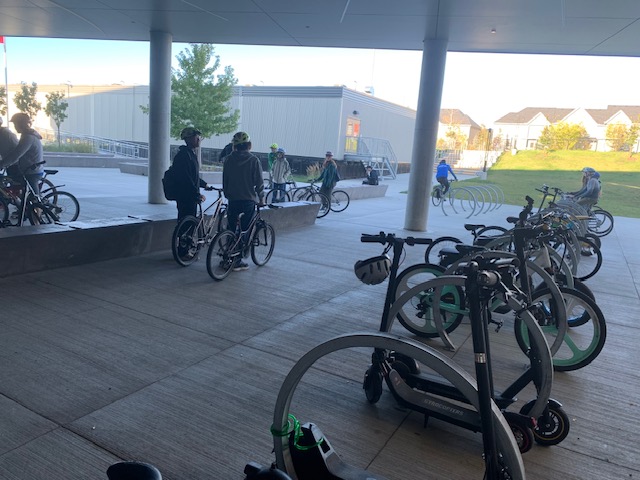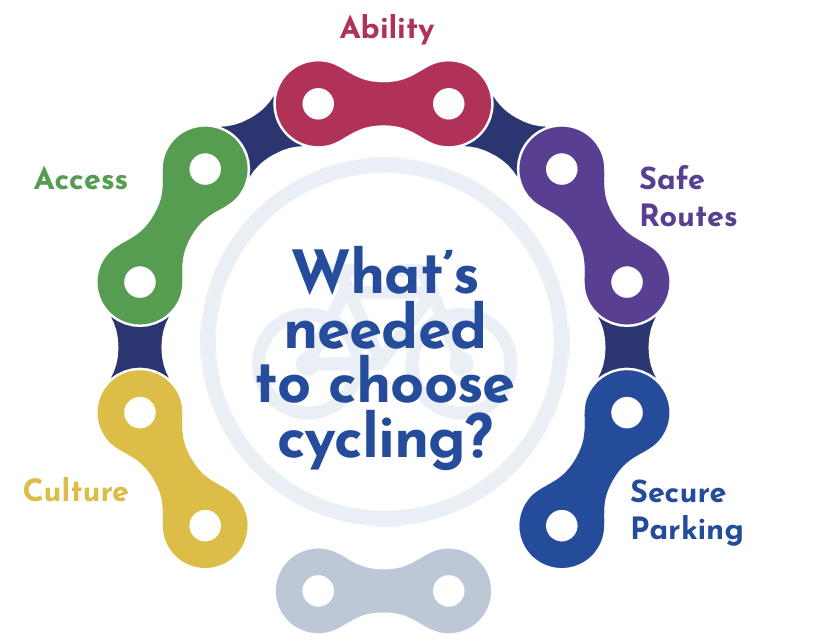
There are five links needed before kids can bike to school and one of those is Secure Bike Parking. Your school may have a bike rack, but if it’s not compatible with today’s bikes, or if its location is inconvenient, or it it has perceived security concerns then it’s less likely it will get used. Our surveys indicate risk of theft is a big deterrent to students cycling to school.
The purpose of this document is to provide a guideline for schools to create great bicycle parking. When students have bike parking that is safe and convenient they are more likely to bike to school.
Why is bike parking so important?
Removing the barrier of poor bike parking allows a school community unlock the benefits riding a bike to school offers to its students:
- Physical activity
- Improves mental health
- Reduces congestion at bell times
- Supports sustainable transportation
Four Bike Parking Considerations
The following principles are the main factors to consider when evaluating the best possible bike parking facilities for your school. Keeping these in mind in your decision making process will ensure you achieve the best results in student ridership!
Bike Parking Principles:
1. Location – Must be convenient, easy to use, close to main entrance and connected to pathways.
2. Security – Take additional measures relative to the location and the neighbourhood risks. This might mean cameras or cages etc.
3. Secure Bike Rack – The Bike Rack must fit today’s bikes and allow frame to be locked to rack.
4. Weather Resilience – Consider covered spaces and snow maintenance plan.
Location
Schools achieve the highest ridership when their bike parking is placed in a convenient and safe location. Far too often bike parking has been treated as a afterthought and placed in the back corner of the school yard or in a parking lot. When students find the parking to be inconvenient, unsafe or they feel their bike is at risk of being stolen, they will choose not to bike.
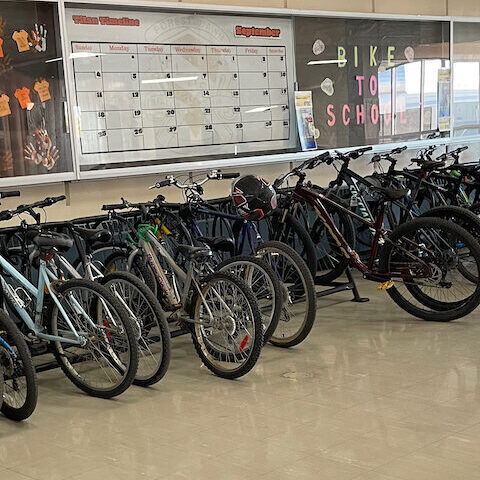
Best Practices:
- Inside the School – A spare classroom, large foyer or unused storage space inside the school makes great bike parking because it can address all 4 principles.
- Courtyard or Fenced Area – When inside is not an option, second choice would be a courtyard or fenced area that is not available or open to the general public. Students should be able to walk their bike through the school to get to this area if needed.
- High Traffic Areas – Most schools must use an outdoor location and in those cases it should be in high traffic area close to a major entrance. Proximity of windows for sight-lines and the ability to have security cameras in range is also a consideration.
Location to avoid:
Behind schools – even if students use back doors, areas behind schools that don’t have regular traffic or have limited or no sight-lines should be avoided. Thieves think they won’t be seen and they often have shorter routes to escape with stolen bicycles.
Capacity – Consider the ability to grow your bike parking to accommodate the standard quantity for your school. You may have limited bike racks today, but if ridership increases you’ll want to plan for more bike parking.
Security
With the location of your school’s bike parking identified, the next principle to consider is security. You will have already factored security when choosing the location, so this principle is about determining what incremental security measures you might need to take given the uniqueness of the location.
Best practices:
- Lighting – There may be times of day, especially in winter, when it may be dark outside when students arrive or depart from school. Does your bike parking have adequate lighting for students to feel secure.
- Security Cameras – Does your school have security cameras in the area that can be adjusted towards the bike parking. Can a new camera be added if needed.
- Bike Cage or Corral – Students must lock their bikes to a rack, but for some locations and with some neighbourhoods, the risk of theft remains high. You may want to consider the additional security of a cage or corral that can be locked while students are in school. This secondary is good way to mitigate the risk of theft.
Re-Evaluating Bike Parking Location – One benefit of moveable racks is that you can change your bike parking location as your school evolves or conditions change. Consider this as you plan. Fixed racks are just that: fixed.
Bike Rack Design
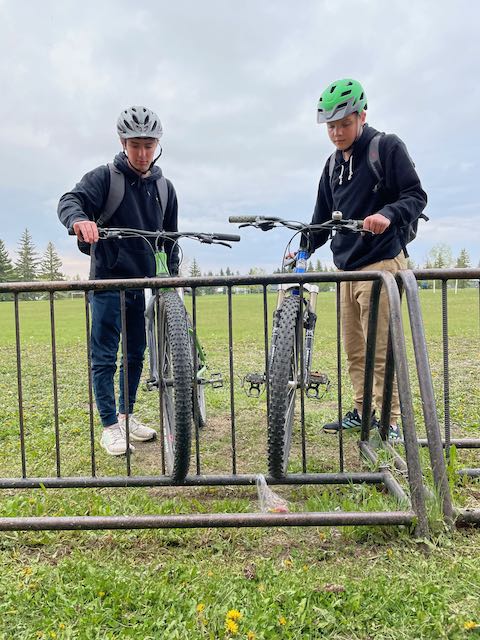
All Racks Should :
- Have two points of contact – prevents bikes from falling over
- Have one point (minimum) to lock the bike frame to the rack that will work for all bike types
- Include pace from a building or curb to allow bikes to sit fully in the rack
- Be securely bolted to existing infrastructure
A secure bike rack is critical in providing parking. Racks that can be cut easily, or don’t have a good locking locations are not good racks.

Locks – Students will need good locks to secure their bike. Your school may want to consider a Bike-Lock Library program to ensure students always have a good lock securing their bikes while parked at the school.
Why Not Wheelbenders?
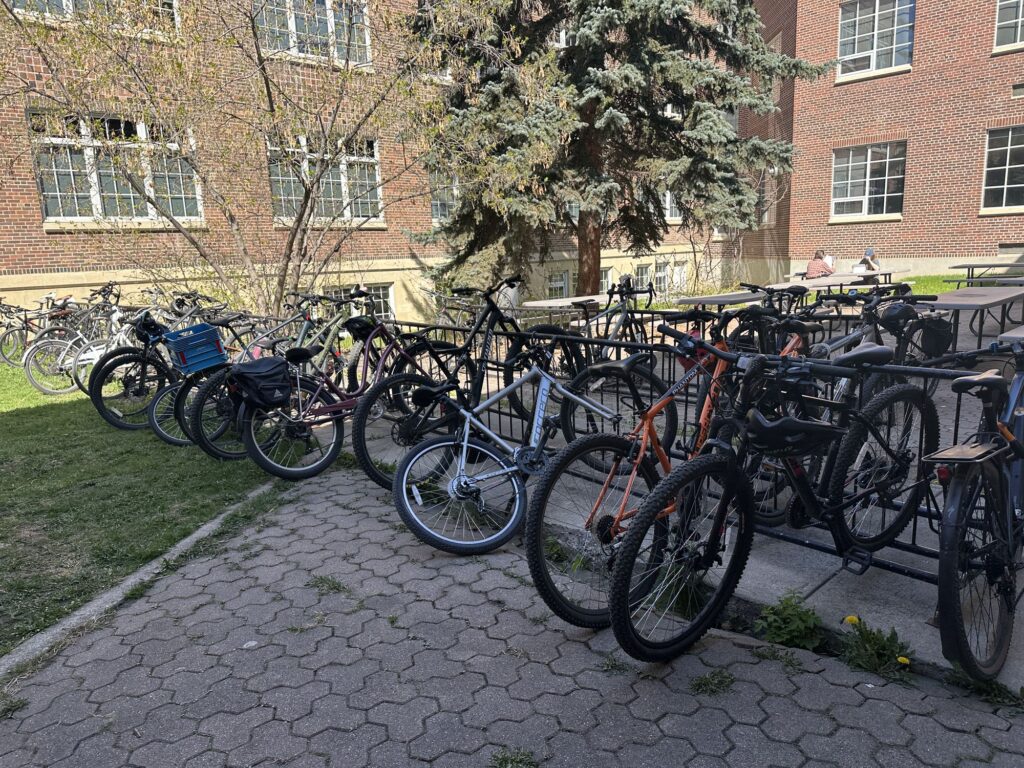
The traditional school bike rack, AKA tire or wheel bender, is not a secure choice. They don’t meet have two points of contact, or ANY locking location. The vertical re-bar slots convince students to lock ONLY the tire, because that is how it is designed. A tire is easily removed. Securly locking requires the bike’s frame to be locked to the rack.
Fortunately there is an inexpensive way to modify wheel bender racks that is more cost effective than buying new racks. Youth En Route has been designing innovative solutions to modifying wheel bender racks.
Staple Racks:
The most versatile, inclusive and secure rack available today is the staple or U-shape rack (also known as a Sheffield Rack). They can be surface mounted, or embedded in the ground.
Not all staple racks are the same. And they can be expensive considering the cost of installation.
Looking for staple racks on a budget? Youth En Route in partnership with the City of Calgary has identified the opportunity to redeploy Maze Gates. Contact us to learn more!

Weather Resilient Parking
How resilient your school’s bike parking is to weather is the last principle to consider.
Rain Check!
Riding a bicycle for recreational purposes is usually considered a fair-weather activity. After all, most people aren’t going to ride their bike for hours in the rain. However, using a bicycle for transportation is different – and it can be a students only mode of transportation. The City of Calgary’s standard for its 5A network is snow clearing. As more routes are built to schools and cleared year-round, we expect more students to ride in more weather.
Best Practices:
- Roof – While costly, roof covered parking may be a good investment especially if your school experiences a lot of rain or snow.
- Snow removal – More students are riding to school year round, even when its cold and snowy. But has your school’s snow management plan included the bike parking? If it doesn’t, your schools bike parking may be out of commission during the winter months.
- Wind Breaks – Finding an area that meets the previous requirements but also offers a wind break could be the best and most cost effective solution for bike parking. These are areas where snow doesn’t collect as much, are still visible to deter theft, and offer a bit of respite from the elements.